Ancient Nemea, Greece.

Panhellenic Sanctuary of Zeus

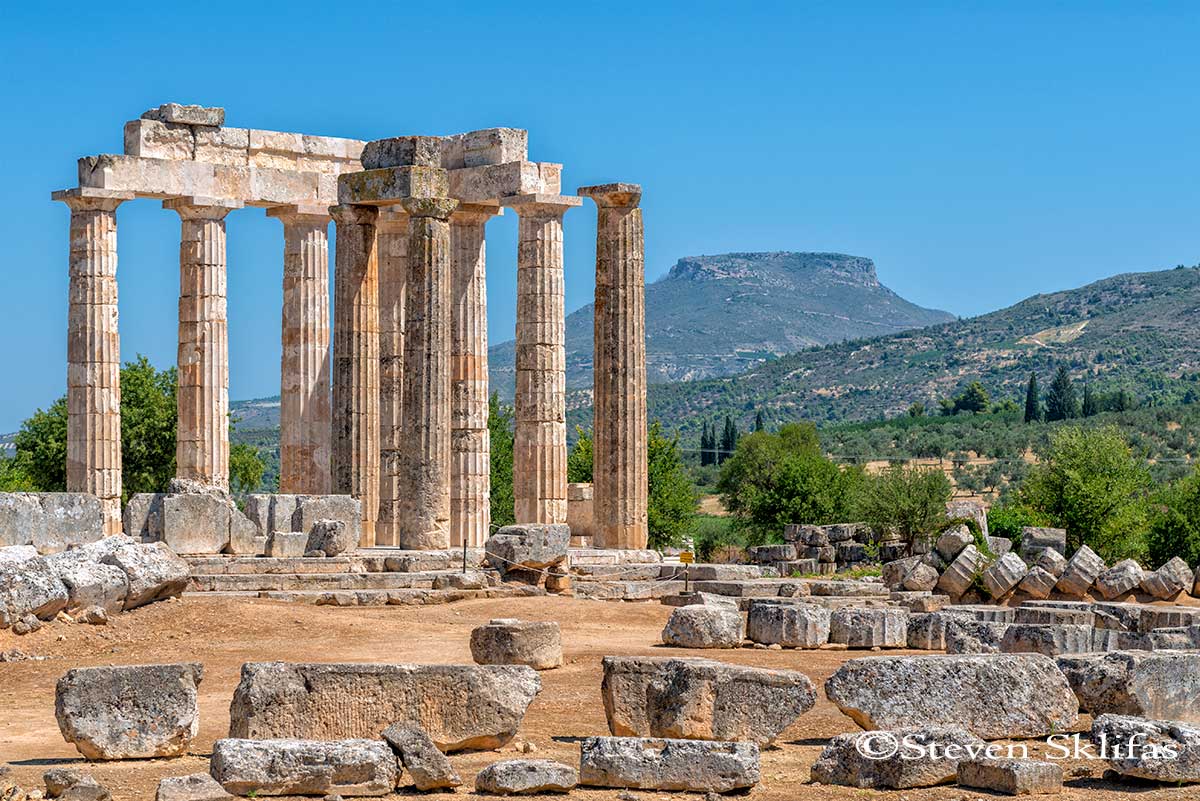
Nemea is on the north-eastern part of the Peloponnese in the prefecture of Corinthia, southern mainland Greece. Ancient Nemea is the old stamping ground of Heracles and a precinct and sanctuary sacred and dedicated to the God of Nemean Zeus.

Situated amongst gentle rolling hills overflowing with Greece’s premier vineyards lays Ancient Nemea, famous in Greek mythology as the place where Heracles slew the ferocious Nemean Lion.

There’s no sign of Heracles these days, but the local red wine is known as the ‘blood of Heracles’ and among the sacred cypress trees at Nemea’s sanctuary of Zeus, the timeless 4th century BC Temple of Nemean Zeus currently endures as the proud witness to the legendary feats of antiquity. 

Nemea was not actually a permanently inhabited town, but one of four famous ancient Greek Panhellenic sanctuaries (Olympia, Delphi and Isthmia were the others) where festivals (Games) took place in rotation in the late summer every two years. During the classical period, all four Games were of an equal importance and the ancient Athenians awarded free meals for life to her citizens who won a crown at any of four games. 

The Nemean Games were established in 573 BC and organised every two years after the model of the Olympic Games, with the emphasis on Athletic contests.

According to the oldest myth, the establishment of the Nemean games is attributed to the death of the prince Opheltes, the infant son of Nemean Priest King Lykourgos and Eurydike.

When Opheltes was born, the King consulted the Pythian oracle of Delphi on how to ensure the well-being of his new son. The Pythian oracle responded the baby must not touch the ground until he could walk. The nursemaid, entrusted by the king to look after his son, was walking through a meadow with the Royal baby when she was approached by the “Seven champions marching against Thebes” asking her for something to quench their thirst. 

The nursemaid placed the infant down momentarily on a bed of wild celery to fetch them water from a nearby stream. Tragically, a snake that lay concealed in the celery killed the baby prince. The “Seven Against Thebes” took this death as a bad omen (which it turned out to be) for their own mission and renamed the baby Archemoros “Beginner of Doom” and to appease the gods they held the funeral games, hence founding the Nemean Games.

In honour of the infant prince Opheltes, the Games Judges wore black robes of mourners and victors received a crown of wild celery. This was normal practice for the duration of the Nemean Games through the centuries.
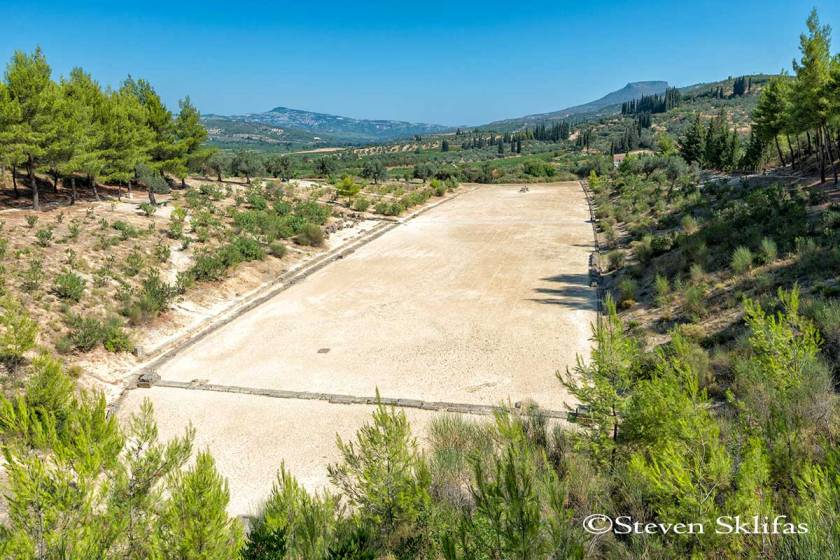
Ancient Greek Stadium. Nemea. Peloponnese. Greece.
Nemea. Peloponnese. Greece. View of the excavated and restored ancient Greek stadium at Nemea which dates from 330 BC. Located 400 meters southeast of the Temple of Zeus amidst scenic landscape, the stadium is partly cut into the hill and the 13 lane 600 ancient feet long running track still has its original starting lines marked with stones.

By the end of the 5th century, the sanctuary of Zeus had been destroyed and the Games were transferred to Argos, a nearby powerful city of ancient Greece. The games returned to Nemea around 330 BC when the city was raised from ruins by a burst of building activity that included a new Temple and Stadium of which are to be seen today. 

Unfortunately, the new prosperity was short-lived when the games were once again transferred to Argos with the sad fact they were never returned to Nemea. Over the following centuries, the sanctuary was abandoned and the temple columns were knocked down and used for other building projects.

Fortunately for us, the temple has been restored in parts and so has the stadium, thanks to the dedicated efforts of many including the University of California at Berkeley operating under the American School of Classical Studies at Athens, and with the permission and supervision of the Archaeological Service of the Ministry of Culture of the Hellenic Republic. The Director of those excavations was Professor Stephen G. Miller.

The Nemean games resumed in 1996 thanks to the Society for the Revival of the Nemean Games, a movement intended to resurrect the competitive and egalitarian spirit of ancient Greek athletics. They have been held every 4 years since and are open to anyone who wishes to take part.

I have been to Ancient Nemea several times and I have always found it a highly rewarding site to visit. It has a splendid museum and the Temple of Nemean Zeus and the Stadium are outstanding examples of their time.

Click to view the complete Ancient Nemea image gallery.

All Images, Text and Content are Copyright Steven Sklifas.

Recommended websites:
https://nemeangames.org/

https://www.opheltes.gr/

https://nemeacenter.berkeley.edu/about-ancient-nemea/

Ancient Messene, Peloponnese Greece

Ancient Messene, also known as Ithomi, lies in the fertile foothills of Mount Ithomi, just below the stone houses of the charming traditional village of Mavromati. It is in the southwest Peloponnese prefecture of Messenia, 32 kilometres northwest of Kalamata.

The classical city-state was founded in 369 BC on the foundation of ruins that go back as far as the Bronze Age. It became the capital of the greater region of Messene after being librated by Theban general Epaminondas, who defeated the Spartans two years earlier (371 BC) at the battle at Leuktra. 

It is said the city was built in 80 days and it follows the famous Hippodamian system in town planning.

The Archaeological Society of Athens has largely excavated and restored the vast archaeological site. It is one and is one of most impressive sites in Greece; however it’s not very well known to most travellers in the region.

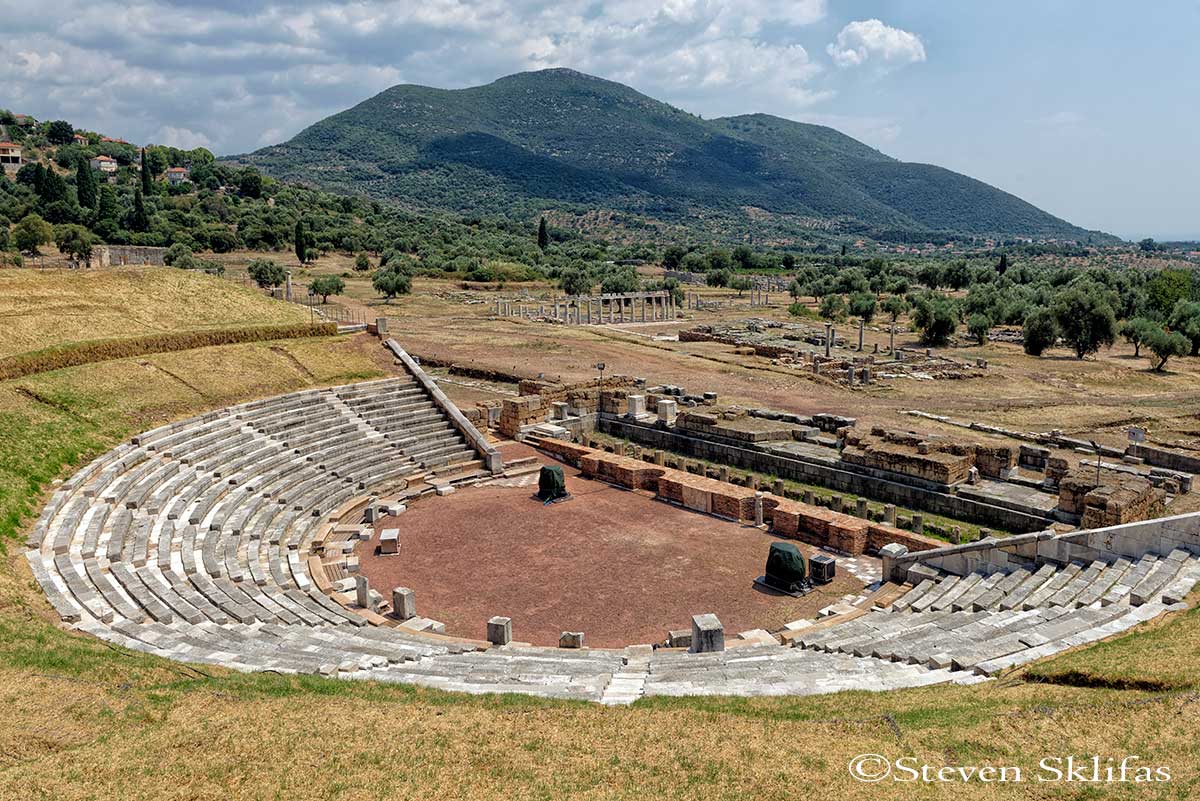
One of the many highlights is the 3rd century BC ancient theatre which has the cavea (seating) carved into the hillside. During the Roman period, the theatre was enlarged, and the façade of the scene building had three storeys. The theatre held the meeting between King Philip V of Macedon and Aratos the Sikyonian in 214 BC; the day following the revolt of the Messenian people.

Further highlights include the Stadium and Gymnasium architectural complex, the 2nd century BC Hellenistic Sanctuary of Asclepius, the political and religious heart of the city and the 9 kilometres long circuit wall, made of enormous limestone blocks and with battlement towers built during the 4th century BC to protect the city.

The archaeological site of ancient Messene is on the UNSECO Tentative List, which comprises properties considered of being cultural and/or natural heritage of outstanding universal value and therefore suitable for inscription on the World Heritage List.

Click here to view the full Ancient Messene Gallery

All text, images and content are copyright Steven Sklifas.   

Ancient Olympia Greece

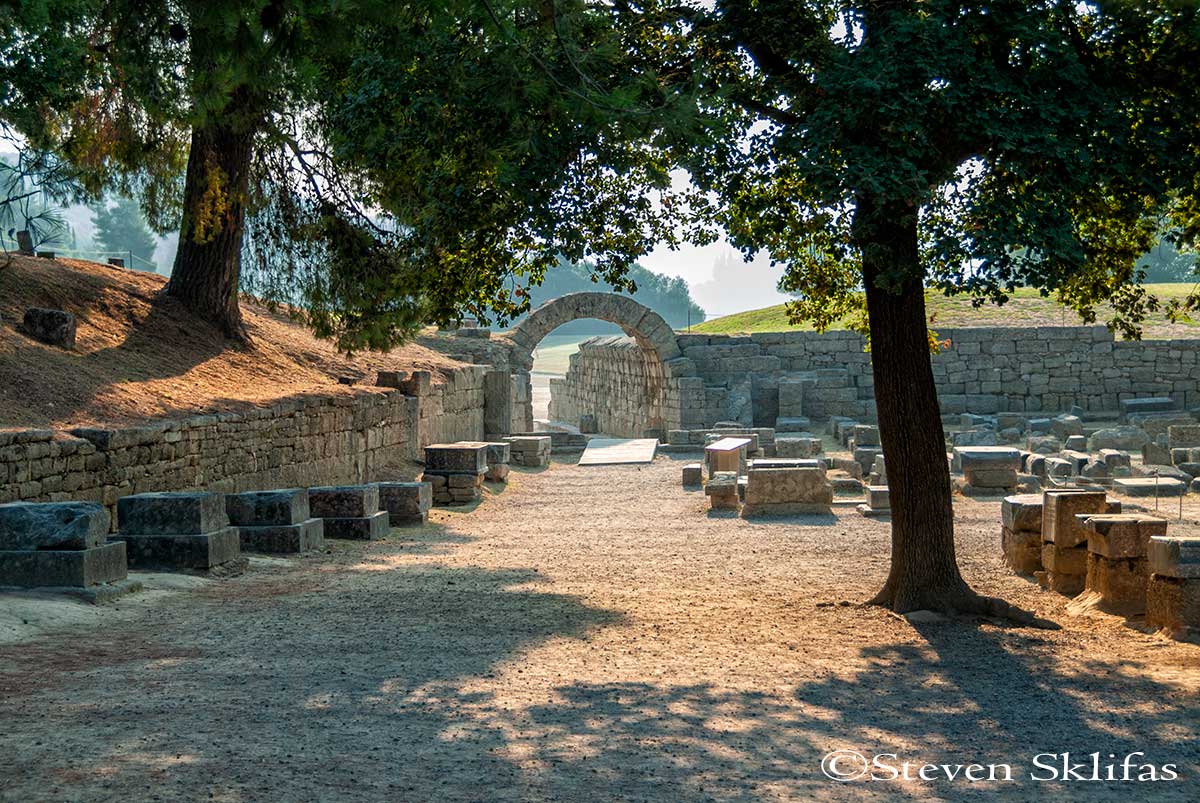
The birthplace and spiritual home of the Olympic Games, Ancient Olympia continues to captivate as it did for a thousand years from 776 BC, when Greeks assembled in war and peace to celebrate the games and life.

Ancient Olympia is magically set in a lush valley between two rivers in the western Peloponnese prefecture of Elia, southern Greece. Dedicated to the Ancient Greek God Zeus, the games which according to one legend were established by Ancient Greek Hero Herakles to honor the achievement of his 12 labours.

The games were held here every fours year’s from 776 BC onwards for over a thousand years and remarkably the champion’s name of each event is recorded.

Amidst its shady groves of pine, olive and blooming Judas trees, Olympia’s evocative ruins of its celebrated past are on show, including the remains of the Palaestra where the athletes trained, the stadium where the foot races were held and the hippodrome where the horse events took place. 

The renowned 2nd century AD Greek traveller, geographer and historian Pausanias declared that although there are many wonderful things in Greece, there is a ’unique divinity’ about the mysteries of Ancient Olympia.

At its centre, in the sacred sanctuary, the glorious 5th century Temple of Zeus lays in ruins. Its colossal Doric columns lay toppled in the ground unmoved since being destroyed by tremendous earthquakes in the 6th century. Comparable in size to the Athenian Parthenon, The Temple of Zeus housed the long-lost 12-metre high golden statue of Zeus, created by the Greek sculptor Pheidias (Phidias) and one of the seven wonders of the ancient world.

Finally, its marvellous museum is full of world-class exhibits and masterpieces of antiquity, including 5th century BC statue of the winged Nike by the sculptor Paeonius (or Paionios) of Mende and the Praxiteles’ marble statue of Hermes, possibly the finest figurative sculpture ever made.

Ancient Olympia is a designated UNESCO World Heritage Site.

Click to view the complete Ancient Olympia image gallery.

All images, text and content are Copyright Steven Sklifas.