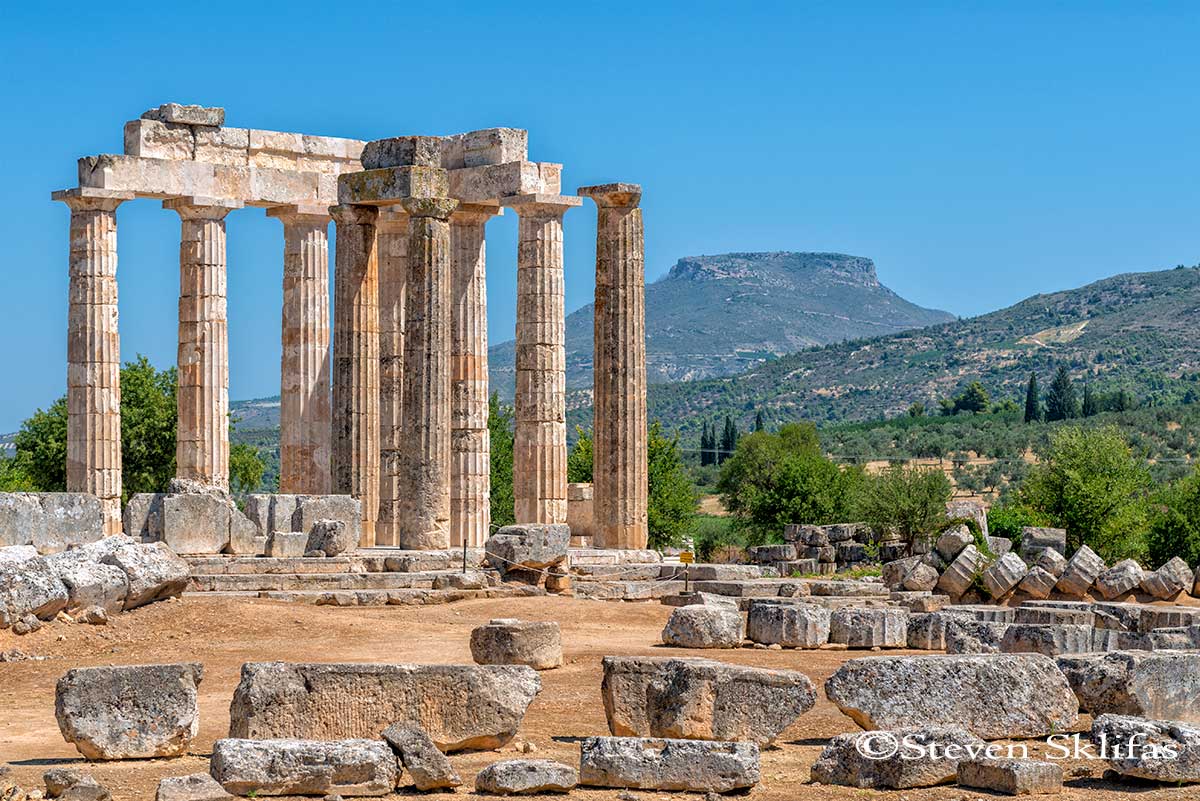
Ancient Nemea, Greece.

Panhellenic Sanctuary of Zeus

Nemea is on the north-eastern part of the Peloponnese in the prefecture of Corinthia, southern mainland Greece. Ancient Nemea is the old stamping ground of Heracles and a precinct and sanctuary sacred and dedicated to the God of Nemean Zeus.

Situated amongst gentle rolling hills overflowing with Greece’s premier vineyards lays Ancient Nemea, famous in Greek mythology as the place where Heracles slew the ferocious Nemean Lion.

There’s no sign of Heracles these days, but the local red wine is known as the ‘blood of Heracles’ and among the sacred cypress trees at Nemea’s sanctuary of Zeus, the timeless 4th century BC Temple of Nemean Zeus currently endures as the proud witness to the legendary feats of antiquity. 

Nemea was not actually a permanently inhabited town, but one of four famous ancient Greek Panhellenic sanctuaries (Olympia, Delphi and Isthmia were the others) where festivals (Games) took place in rotation in the late summer every two years. During the classical period, all four Games were of an equal importance and the ancient Athenians awarded free meals for life to her citizens who won a crown at any of four games. 

The Nemean Games were established in 573 BC and organised every two years after the model of the Olympic Games, with the emphasis on Athletic contests.

According to the oldest myth, the establishment of the Nemean games is attributed to the death of the prince Opheltes, the infant son of Nemean Priest King Lykourgos and Eurydike.

When Opheltes was born, the King consulted the Pythian oracle of Delphi on how to ensure the well-being of his new son. The Pythian oracle responded the baby must not touch the ground until he could walk. The nursemaid, entrusted by the king to look after his son, was walking through a meadow with the Royal baby when she was approached by the “Seven champions marching against Thebes” asking her for something to quench their thirst. 

The nursemaid placed the infant down momentarily on a bed of wild celery to fetch them water from a nearby stream. Tragically, a snake that lay concealed in the celery killed the baby prince. The “Seven Against Thebes” took this death as a bad omen (which it turned out to be) for their own mission and renamed the baby Archemoros “Beginner of Doom” and to appease the gods they held the funeral games, hence founding the Nemean Games.

In honour of the infant prince Opheltes, the Games Judges wore black robes of mourners and victors received a crown of wild celery. This was normal practice for the duration of the Nemean Games through the centuries.
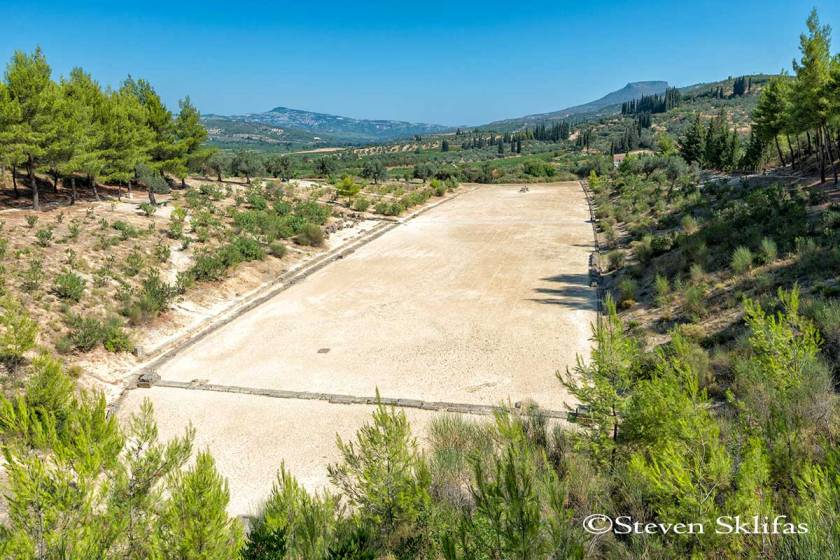
Ancient Greek Stadium. Nemea. Peloponnese. Greece.
Nemea. Peloponnese. Greece. View of the excavated and restored ancient Greek stadium at Nemea which dates from 330 BC. Located 400 meters southeast of the Temple of Zeus amidst scenic landscape, the stadium is partly cut into the hill and the 13 lane 600 ancient feet long running track still has its original starting lines marked with stones.

By the end of the 5th century, the sanctuary of Zeus had been destroyed and the Games were transferred to Argos, a nearby powerful city of ancient Greece. The games returned to Nemea around 330 BC when the city was raised from ruins by a burst of building activity that included a new Temple and Stadium of which are to be seen today. 

Unfortunately, the new prosperity was short-lived when the games were once again transferred to Argos with the sad fact they were never returned to Nemea. Over the following centuries, the sanctuary was abandoned and the temple columns were knocked down and used for other building projects.

Fortunately for us, the temple has been restored in parts and so has the stadium, thanks to the dedicated efforts of many including the University of California at Berkeley operating under the American School of Classical Studies at Athens, and with the permission and supervision of the Archaeological Service of the Ministry of Culture of the Hellenic Republic. The Director of those excavations was Professor Stephen G. Miller.

The Nemean games resumed in 1996 thanks to the Society for the Revival of the Nemean Games, a movement intended to resurrect the competitive and egalitarian spirit of ancient Greek athletics. They have been held every 4 years since and are open to anyone who wishes to take part.

I have been to Ancient Nemea several times and I have always found it a highly rewarding site to visit. It has a splendid museum and the Temple of Nemean Zeus and the Stadium are outstanding examples of their time.

Click to view the complete Ancient Nemea image gallery.

All Images, Text and Content are Copyright Steven Sklifas.

Recommended websites:
https://nemeangames.org/

https://www.opheltes.gr/

https://nemeacenter.berkeley.edu/about-ancient-nemea/

Petra Jordan,

Rose Red ancient Nabataean Capital

Hidden amongst the towering jagged red sandstone peaks between the Red Sea and the Dead Sea in Jordan is Petra, a distinctive ancient capital city, skilfully built and carved into the rock face by the ancient Nabataeans (Nabataens).

The Nabataeans were a dynamic North Arabian nomadic people who settled at Petra over 2200 thousand years ago (possibly as early as the 6th century BC). During their time, Petra prospered as an important caravan trade crossroad that linked the near East, Africa, India, with the Mediterranean.

Despite being set in one of the world’s harshest environment Petra, which means ‘stone’ in Greek, endured as a liveable city. Its longevity was mainly because of the brilliance of the ancient Nabataeans who were able to engineer advanced complex hydraulic water systems that would harness and conserve precious water from the seasonal flash floods.

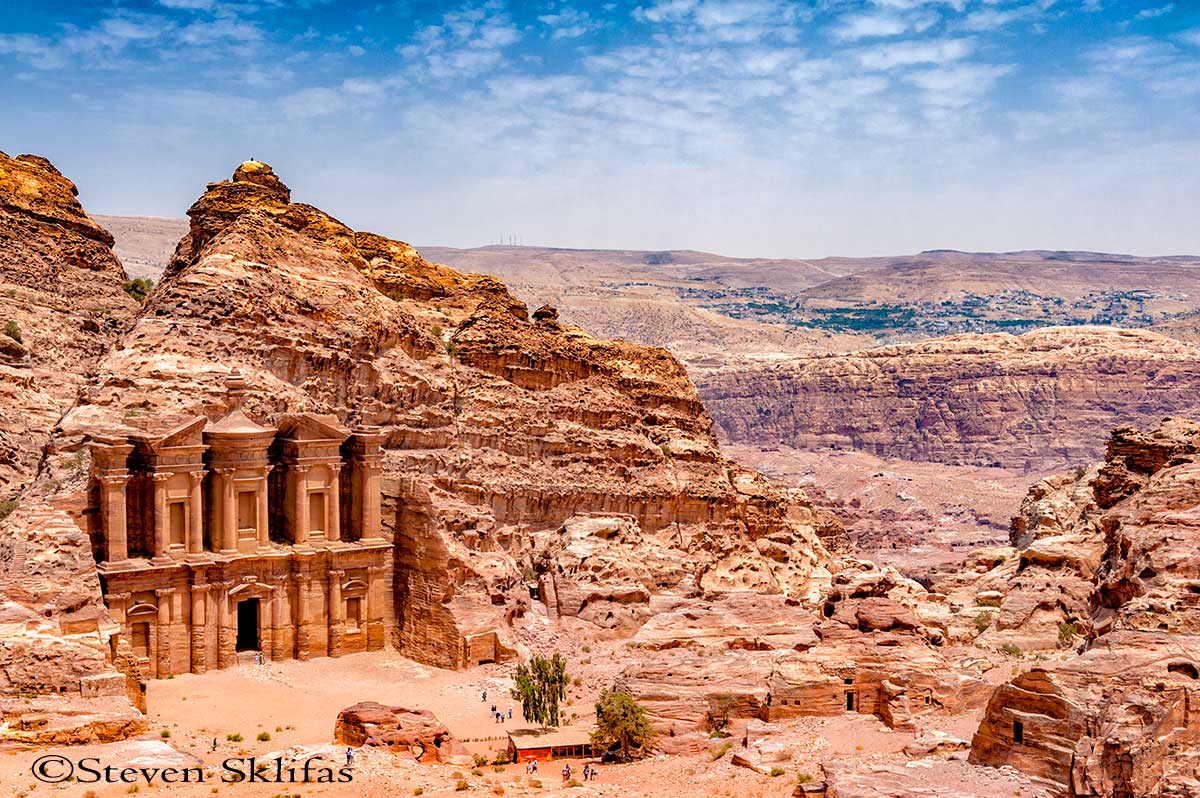
Feature image of the post is of the legendary Monastery, which is the most awe-inspiring monument of Petra. Dating from the third century BC, the Monastery is hidden above the hills and at least 60 minutes’ climb from the ancient city’s centre. Carved into the side of a mountain, the Monastery’s timeless Hellenistic facade is similar in design to that of the Treasury, although far larger at 45 meters high and 50 meters wide.

Rediscovered in 1812 by Swiss explorer John Lewis Burckhardt after being lost to the World for hundreds of years, Petra is one of the world’s most famous, richest and largest archaeological sites.

The splendours of Petra’s architecture are a fusion of Greek, Syrian, Arabian and Roman elements and a walk through the city will reveal of hundreds of rock carved tombs, elegant Hellenistic temple facades, funerary halls and rock reliefs and even a classical style theatre.

It is a UNESCO world heritage listed site and UNESCO has described it as “one of the most precious cultural properties of man’s cultural heritage”.

Click to view the complete Petra images gallery

All images, text and content are copyright Steven Sklifas

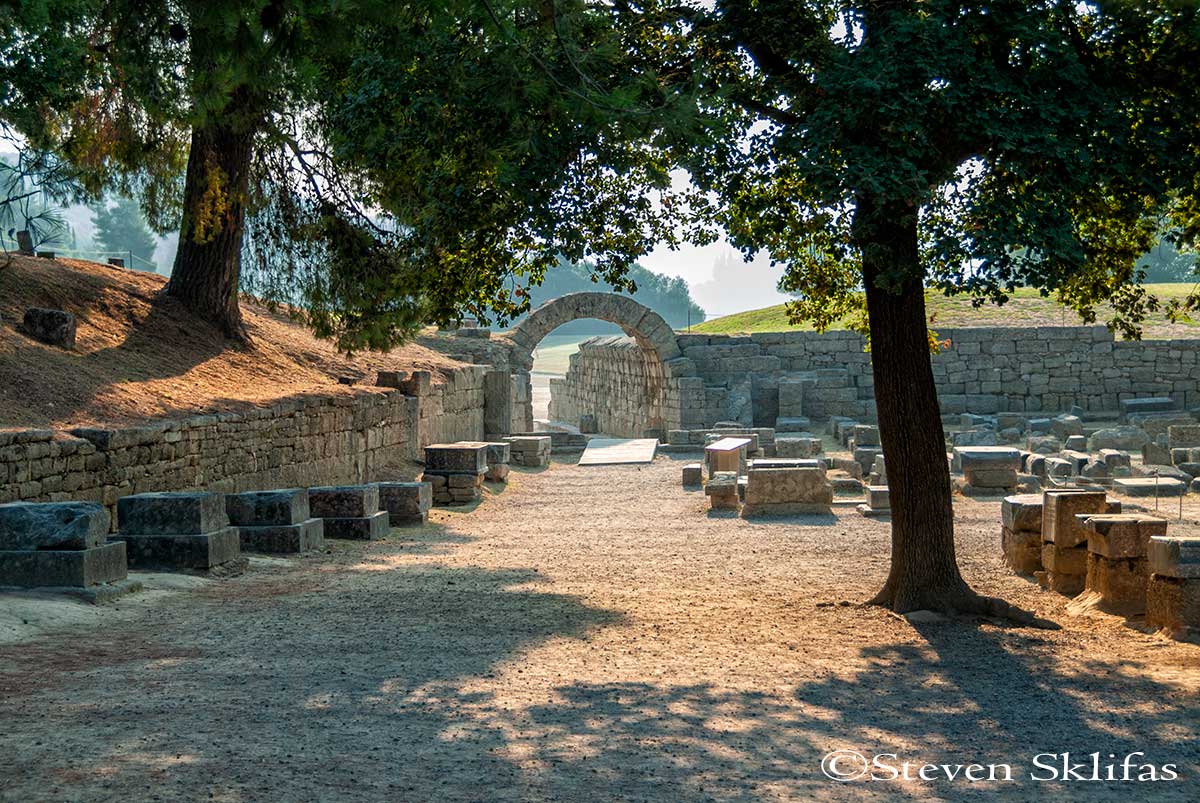
Ancient Olympia Greece

The birthplace and spiritual home of the Olympic Games, Ancient Olympia continues to captivate as it did for a thousand years from 776 BC, when Greeks assembled in war and peace to celebrate the games and life.

Ancient Olympia is magically set in a lush valley between two rivers in the western Peloponnese prefecture of Elia, southern Greece. Dedicated to the Ancient Greek God Zeus, the games which according to one legend were established by Ancient Greek Hero Herakles to honor the achievement of his 12 labours.

The games were held here every fours year’s from 776 BC onwards for over a thousand years and remarkably the champion’s name of each event is recorded.

Amidst its shady groves of pine, olive and blooming Judas trees, Olympia’s evocative ruins of its celebrated past are on show, including the remains of the Palaestra where the athletes trained, the stadium where the foot races were held and the hippodrome where the horse events took place. 

The renowned 2nd century AD Greek traveller, geographer and historian Pausanias declared that although there are many wonderful things in Greece, there is a ’unique divinity’ about the mysteries of Ancient Olympia.

At its centre, in the sacred sanctuary, the glorious 5th century Temple of Zeus lays in ruins. Its colossal Doric columns lay toppled in the ground unmoved since being destroyed by tremendous earthquakes in the 6th century. Comparable in size to the Athenian Parthenon, The Temple of Zeus housed the long-lost 12-metre high golden statue of Zeus, created by the Greek sculptor Pheidias (Phidias) and one of the seven wonders of the ancient world.

Finally, its marvellous museum is full of world-class exhibits and masterpieces of antiquity, including 5th century BC statue of the winged Nike by the sculptor Paeonius (or Paionios) of Mende and the Praxiteles’ marble statue of Hermes, possibly the finest figurative sculpture ever made.

Ancient Olympia is a designated UNESCO World Heritage Site.

Click to view the complete Ancient Olympia image gallery.

All images, text and content are Copyright Steven Sklifas.

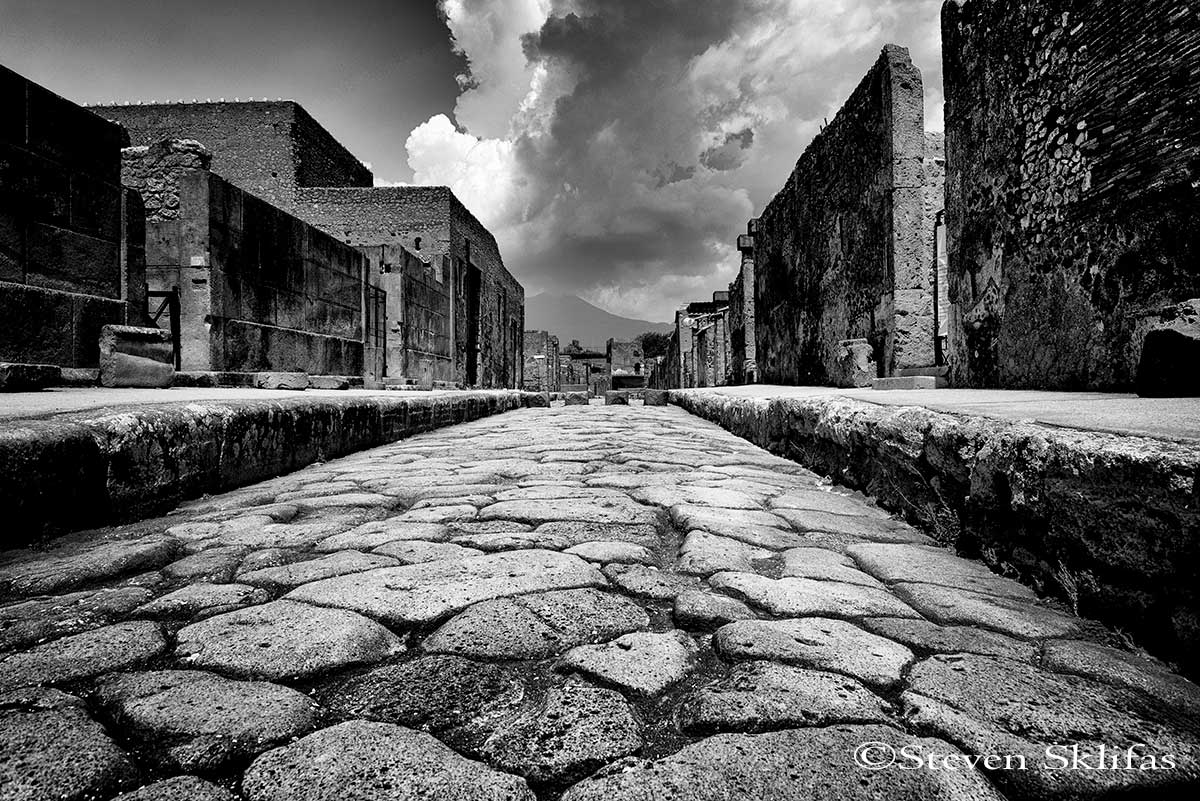
Pompeii Italy.

Providing a breathtaking illusion of antiquity, the ancient city of Pompeii is near the bay of Naples in the southern Italian region of Campania and is still and forever shadowed by its tormentor, Mount Vesuvius.

According to myth, the Greek hero Herakles bestowed upon Pompeii its name whilst passing through Italy after defeating the three-headed monster giant Geryon. The name Pompeii derives from the word Pompe/Pompa, the Ancient Greek word for the procession in honour of Herakles’s triumph over the giants as one of his twelve labours.

The Campanian Oscan, a local italic population, established Pompeii on the end of ancient lava flow sometime around the 8th century BC. It was only a small site. Pompeii’s foundation, as we know of today, is attributed to the ancient Greeks, who took full control of the region and transformed Pompeii (and nearby city of Herculaneum) into an important trading centre and port.

The city developed and grew especially under the powerful influence of the nearby ancient Greek coastal colonies of Cumae and Neapolis (Naples). The beginnings of the city planning and buildings were established during this period. 

The Greek political influence diminished when Pompeii fell under the control of the Etruscans and then the Samnites and in 290 BC the city became a subject ally of Rome. However, Greek (Hellenistic) culture continued to be the leading influence, especially in art, architecture, religion and way of life.

Pompeii became a Roman colony in 80 BC and by now was the largest trading centre in the southern portion of the coast.

The city was bursting with wealth and was transformed with new public buildings and monuments. Many large villas with mosaic floors, Greek art and garden courtyards were built for its wealthy citizens.

The city became a favourite resort of the opulent Romans and model place for families to settle.

It all sounded too good to be true when In AD 62, Mount Vesuvius, now stirring, gave warning of its destructive power when Pompeii was devastated by a major earthquake. However, warning signs were mostly ignored and Pompeii, now with a booming population of about 20,000 inhabitants, choose to rise above the ruins and continued to grow and prosper whilst rebuilding and restoring its damaged buildings and infrastructure. 

The reconstruction of the city was in full swing when the catastrophic eruption of Mount Vesuvius occurred in AD 79 (August 24, according to some historians). 

In just over two days, Pompeii was buried under volcanic debris (lapilli, ash and red-hot scoria) between 5  to 7 metres deep. At least 2000 people who choose to stay in Pompeii and see it out were trapped and died. Poisonous gases killed some others who escaped the city whilst trying to reach safe ground.

Pompeii was lost to the world for around 1500 years, when rediscovered accidentally around 1600. Small-scale excavations started around 1748 and then finally, in 1860, large-scale scientific and systematic excavations organised by the Italian government were underway. Today, around three-fifths of Pompeii have been excavated.

Pompeii is a vast site and even at the peak of the summer tourist season, I could capture images with no people in the vicinity. I highly recommended you visit it if you get the chance. Ideally, you will set aside a full day for it. Pompeii is a UNESCO World Heritage Site.

The complete Pompeii image gallery.

All Images, Text and Content Are Copyright Steven Sklifas.