Hidden amongst the towering jagged red sandstone peaks between the Red Sea and the Dead Sea in Jordan is Petra, a distinctive ancient capital city, skilfully built and carved into the rock face by the ancient Nabataeans (Nabataens).
The Nabataeans were a dynamic North Arabian nomadic people who settled at Petra over 2200 thousand years ago (possibly as early as the 6th century BC). During their time, Petra prospered as an important caravan trade crossroad that linked the near East, Africa, India, with the Mediterranean.
Despite being set in one of the world’s harshest environment Petra, which means ‘stone’ in Greek, endured as a liveable city. Its longevity was mainly because of the brilliance of the ancient Nabataeans who were able to engineer advanced complex hydraulic water systems that would harness and conserve precious water from the seasonal flash floods.
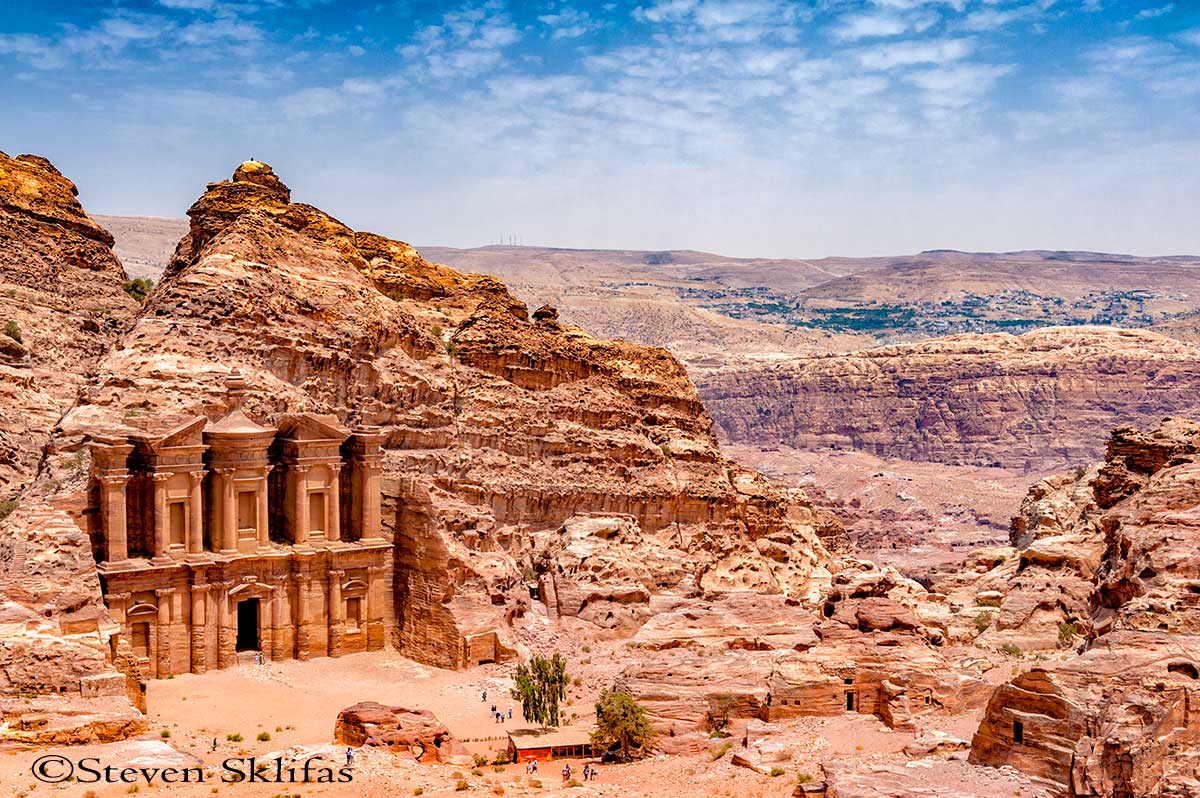
Feature image of the post is of the legendary Monastery, which is the most awe-inspiring monument of Petra. Dating from the third century BC, the Monastery is hidden above the hills and at least 60 minutes’ climb from the ancient city’s centre. Carved into the side of a mountain, the Monastery’s timeless Hellenistic facade is similar in design to that of the Treasury, although far larger at 45 meters high and 50 meters wide.
Rediscovered in 1812 by Swiss explorer John Lewis Burckhardt after being lost to the World for hundreds of years, Petra is one of the world’s most famous, richest and largest archaeological sites.
The splendours of Petra’s architecture are a fusion of Greek, Syrian, Arabian and Roman elements and a walk through the city will reveal of hundreds of rock carved tombs, elegant Hellenistic temple facades, funerary halls and rock reliefs and even a classical style theatre.
It is a UNESCO world heritage listed site and UNESCO has described it as “one of the most precious cultural properties of man’s cultural heritage”.
A frantic exodus of birds can only mean one thing, a predator, a feared Collared Sparrowhawk.
Looking out from my kitchen window, I witness and hear a chaotic scramble of birds taking flight away from the serenity of my backyard. These feathered friends, which include Sparrows, Spotted Doves, Crested pigeons and Miners, startle easily, but on this occasion, my sense was they feared for their life.
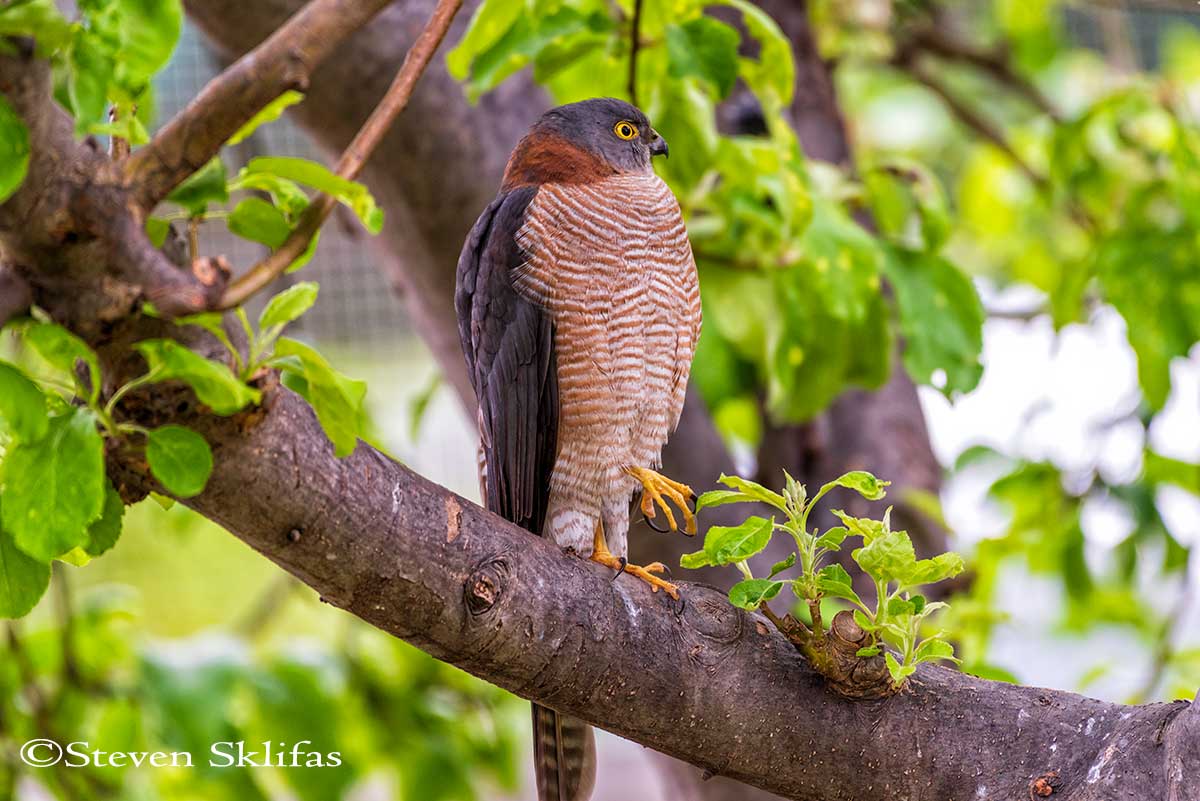
As stepped outside, it confirmed my feeling as sitting quietly, almost nonchalantly on a branch of my apple tree was a Collared Sparrowhawk (Accipiter cirrocephalus), a striking deadly raptor and bird of prey.
Sparrows and various other small birds that frequent my and my neighbours’ backyards in the northern suburbs of Melbourne, Australia have particularly attracted predators that are skilled in hunting small birds.
Confident and relaxed, this modern feathered dinosaur (a Velociraptor to be exact) was not all unsettled by my schoolboy type enthusiasm to set up my camera to capture images. Occasionally, it gave me the death stare with those wide, piercing yellow eyes, perhaps warning me to keep my distance.
Everyone likes birds. What wild creature is more accessible to our eyes and ears, as close to us and everyone in the world, as universal as a bird? – Sir David Attenborough
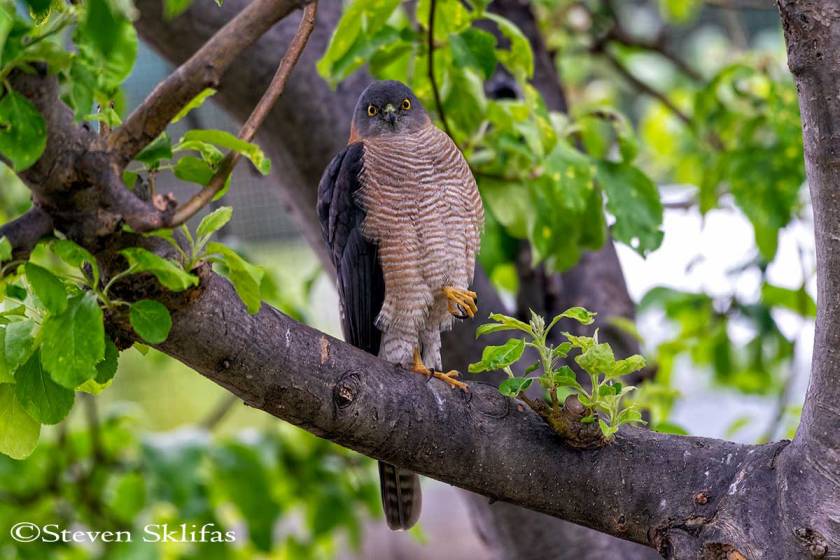
A Collared Sparrowhawk (Accipiter cirrocephalus), a striking deadly raptor and bird of prey.
View of a Collared Sparrowhawk (Accipiter cirrocephalus), a striking deadly raptor and bird of prey. I took the image in my backyard. Melbourne. Australia.
Found in woodlands and forests across Australia, Collared Sparrowhawks are handsomely marked, with slate-grey wings and head, chestnut rear neck collar and reddish-brown and cream banded chest and front.
Living an average of only 4 years, males and female Collared Sparrowhawks are similar in appearance; However, females are larger than males.
Birds of Prey or raptors females are between 20-100 percent larger than the males. This is the opposite of most other birds, where males are larger than females.
A distinguishing feature of the Collared Sparrowhawk is that it has long thin wiry yellow legs and a long middle toe, which it uses to clutch its unfortunate victim. This is one feature that differs from the Brown Goshawk, for which it is mistaken for.
My charismatic visitor eventually tired of my antics and flew off, perhaps to enchant another mere mortal or more likely, to find a meal.
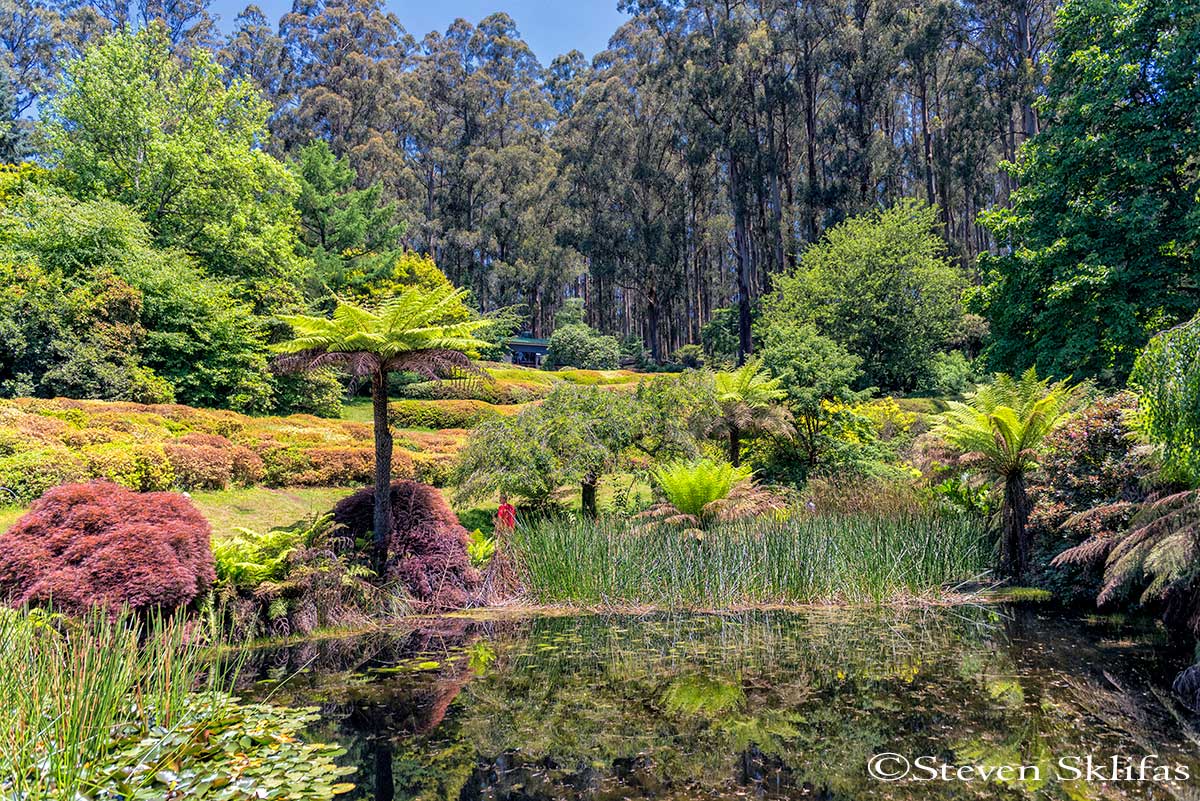
Nestled near the mountain village of Olinda, one hour’s drive from central Melbourne, is the Dandenong Ranges Botanic Garden, a showcase of stunning exotic and native flora.
A dazzling exhibit of the wonderments of nature, the garden is one of the key allures of the Dandenong Ranges, which is set in the low mountain ranges roughly 600 metres above sea level.
Formerly recognised as the National Rhododendron Garden, the vast 40-hectare Garden (100 acres) includes an extensive range of cool-climate plants along with 30,000 Rhododendron and Azalea species and hybrids.
Entry is free, and I spent a relaxed two hours meandering the 5 km of paved walkways during a recent summer visit and was delighted with the diversity of plant life and arrangement of the garden.
“The Dandenong Ranges Botanic Garden is Victoria’s premier cool-climate garden. With breathtaking views over the Yarra Valley, the garden features important collections of rhododendrons, azaleas, camellias and more, in a setting of native and exotic trees. Seasonal changes ensure the garden is a year-round delight,” Quote from the Parks Victoria website.
All images, text and content are copyright Steven Sklifas.
Dazzling pincushion flowers of the Leucospermum ‘Scarlet Ribbons’ plant, a member of the Proteaceae family. Dandenong Ranges Botanic Garden. Victoria. Australia. Native to Southern Africa, the genus Protea was named in 1735 after the Greek Sea God Proteus, who could change his form at will.
What does an obscure photographer stuck in the concrete landscape of an Australian suburb and Claude Monet, a French impressionist master, have in common?… the love for nature, gardening, flowers and the symphonies of colours.
‘The richness I achieve comes from Nature, the source of my inspiration.’ – Claude Monet
Born on 14 November 1840, Claude Monet is one of the most significant, influential and universally celebrated figures in the history of Art. Monet was a founder of French Impressionist painting (late 1800s) which focused on emotions, form and changing light and movement rather than realism.
Impression, Sunrise, a most splendid painting by Monet, is credited to inspiring the name of the impressionist movement.
Monet is perhaps most famous for his monumental series of oil paintings depicting water lilies, serene gardens, and Japanese footbridges. Monet’s water lily series was painted on his property in the village of Giverny, in northern France, where he lived his final 43 years from 1883 to his death on 5 December 1926.
Throughout his life, Monet grew flowers and cherished gardening and being outdoors, at one with nature. In his later years, specifically during his life at Giverny, he became a zealous student of botany.
Monet was the architect and visionary of the extensive and splendid landscaped gardens (five acres of flowerbeds and water-lily ponds) which became the subjects of some of his famous masterpieces.
‘My garden is my most beautiful masterpiece.’ – Claude Monet
To achieve his grand vision, he devoted himself to flower gardening and employed several gardeners for additional support. He sourced and imported plants, some rare, from around the world including irises, daises, nasturtiums peonies, delphiniums, rhododendrons, Oriental poppies, asters and many species of sunflowers and the water lilies for his famous lily pond.
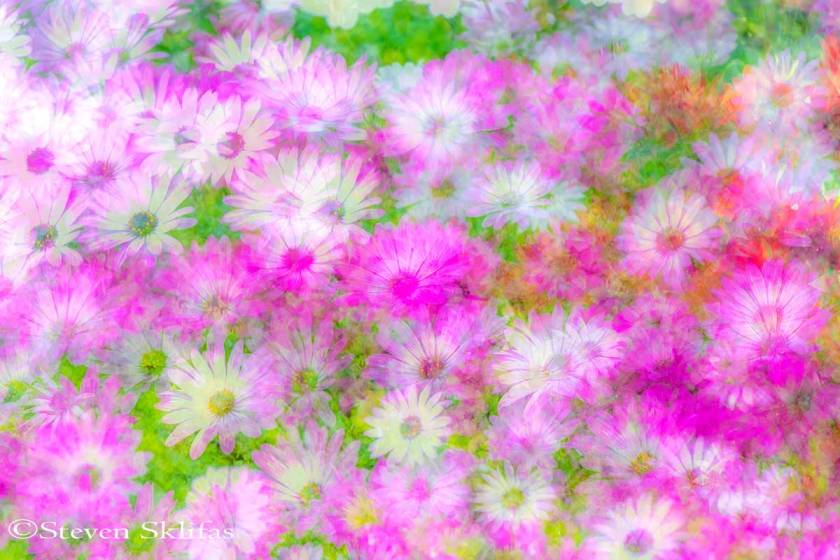
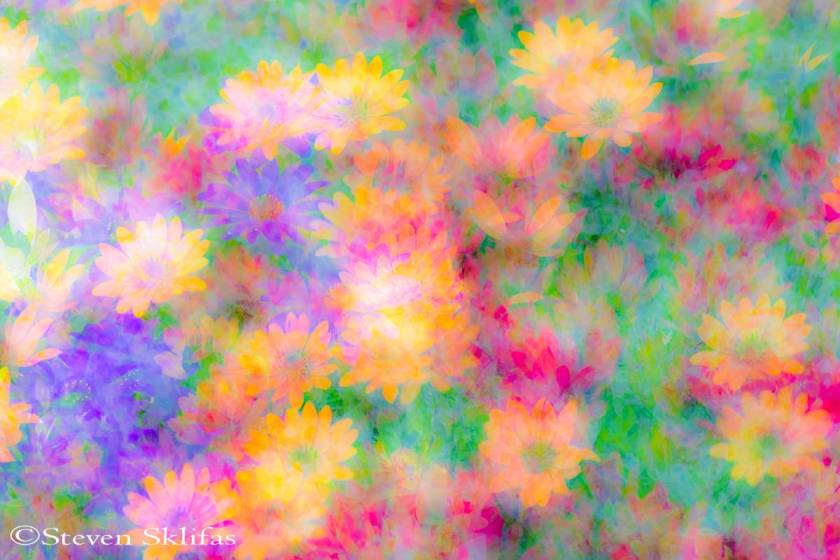
Multiple exposure of Osteospermums (African daisy) flowers in which I layered many exposures to create a single image in-camera.
Monet didn’t let finances impede attaining his dream, and he said, “All my money goes into my garden,” but also: “I am in raptures.”
Today Monet’s house and gardens attract over half a million visitors each year, testament to his visionary brilliance. It was Monet’s love of plants and flowers and not painting that inspired him to transform his property into an oasis.
And as Monet, I created my garden beds purely for the pure joy, inspiration, and companionship that plants and flowers provide. Graceful, enchanting and full of zest, flowers with all their eccentricities and richness of colours never cannot captivate the senses. As with Monet, I can’t imagine life without being surrounded by nature.
‘I must have flowers, always, and always.’ – Claude Monet.
Images included in this post (and found in my image gallery) were captured in my garden. I concentrated on my collection of showy merry African daisies (Osteospermum) of which I clearly adore. The scientific name is developed from the Greek osteon (bone) and Latin spermum (seed).
As homage to Monet, several of the photographs are impressionistic in style, with a dreamy soft, almost defocused effect, gushing with vibrant colours.
I used the multiple exposure photographic technique, also known as Intentional Camera Movement (ICM). I superimposed nine exposures to create a single image in camera. I then converted raw files into jpegs with very minor basic adjustments in Photoshop.
Ancient Messene, also known as Ithomi, lies in the fertile foothills of Mount Ithomi, just below the stone houses of the charming traditional village of Mavromati. It is in the southwest Peloponnese prefecture of Messenia, 32 kilometres northwest of Kalamata.
The classical city-state was founded in 369 BC on the foundation of ruins that go back as far as the Bronze Age. It became the capital of the greater region of Messene after being librated by Theban general Epaminondas, who defeated the Spartans two years earlier (371 BC) at the battle at Leuktra.
It is said the city was built in 80 days and it follows the famous Hippodamian system in town planning.
The Archaeological Society of Athens has largely excavated and restored the vast archaeological site. It is one and is one of most impressive sites in Greece; however it’s not very well known to most travellers in the region.
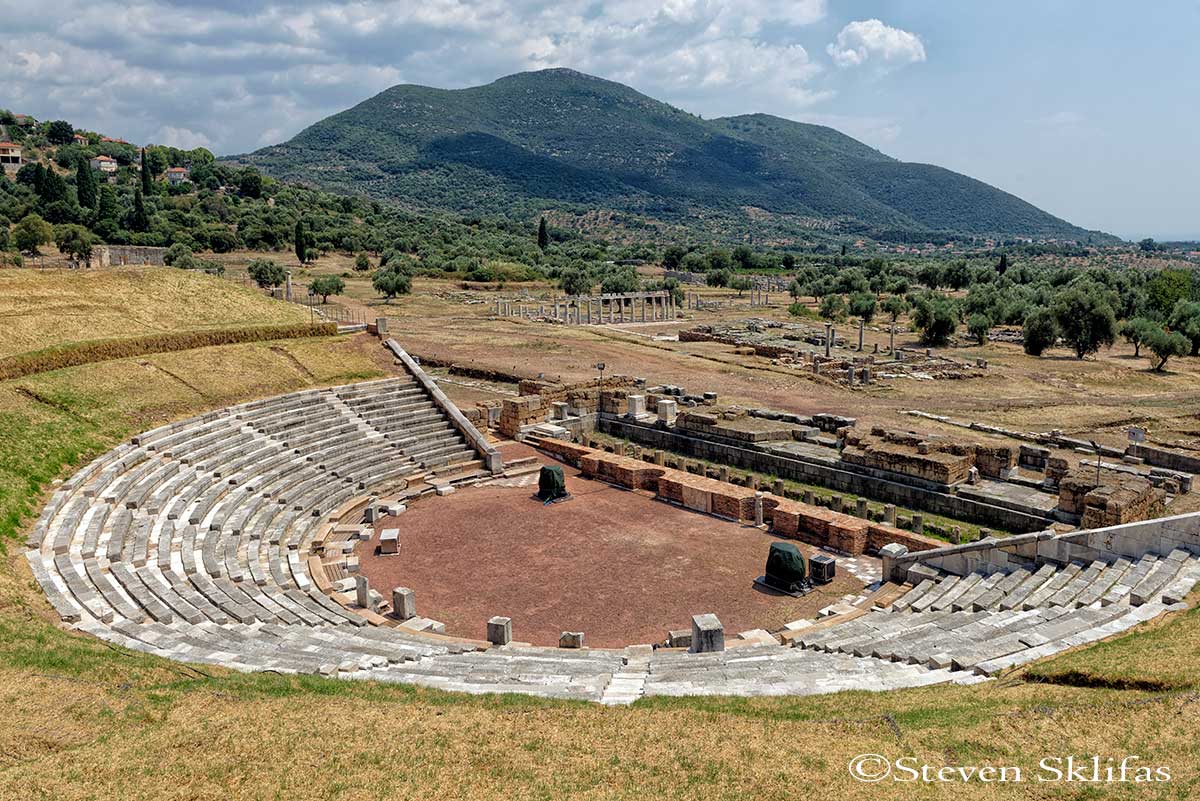
One of the many highlights is the 3rd century BC ancient theatre which has the cavea (seating) carved into the hillside. During the Roman period, the theatre was enlarged, and the façade of the scene building had three storeys. The theatre held the meeting between King Philip V of Macedon and Aratos the Sikyonian in 214 BC; the day following the revolt of the Messenian people.
Further highlights include the Stadium and Gymnasium architectural complex, the 2nd century BC Hellenistic Sanctuary of Asclepius, the political and religious heart of the city and the 9 kilometres long circuit wall, made of enormous limestone blocks and with battlement towers built during the 4th century BC to protect the city.
The archaeological site of ancient Messene is on the UNSECO Tentative List, which comprises properties considered of being cultural and/or natural heritage of outstanding universal value and therefore suitable for inscription on the World Heritage List.
The 18th century Royal Palace or Reggia di Caserta is Italy’s most magnificent Palace and one of Europe’s grandest Royal residences and its immense park garden is one of the most dazzling in Europe.
The Palace or Palazzo Reale was built at the behest of Charles III of Bourbon (who never ended up living there). Designed by Luigi Vanvitelli, southern Italy’s greatest architect, the construction of the Palace began in 1752 and completed in 1774.
Palace and garden were to be the pride of the Bourbon monarchy and be so beautiful as to rival and even overshadow Versailles in France.
The lavish and vast Baroque Palace comprises five storeys, 43 staircases, 1,790 windows and 1,200 rooms all arranged around four courtyards.
The royal park, also designed to rival the gardens of Versailles, stretches for 3 kilometres across the park in a straight line from behind the Royal Palace.
The immense avenue is flanked by hornbeam hedges and lined by narrow lawns and punctuated by stepped cascades, ponds, groups of statues and fountains with mythological themes. The avenue finally ends up at the base of the great cascade, a waterfall some 75 metres high which tumbles into the basin of Diana and Actaeon.
There is also a Botanical Garden known as the English Garden. The garden was the first of its type on the European mainland and is in the naturalistic style similar to those created by the famous English Landscape architect Lancelot ‘Capability’ Brown.
Caserta is located 40 km north of Naples in the Southern Italian region of Campania. I have made the trip many times via train from Rome. The station is opposite the Palace.
The Palace complex was designated a UNESCO World Heritage Site in 1997.
Facing California Redwoods is a surreal experience, one I was unprepared for when I entered nature’s majestic cathedral.
Researching the internet for day trips, I stumbled onto a website that had information about a forest of redwoods, near the township of Warburton, a pleasant 90 minutes’ drive from where I live in the northern suburbs of Melbourne, Australia.
From a young age, I have had a fascination with redwoods, so to discover that I could actually see them without flying 12,000 kilometres to California was quite incredible. Excited, I went the very next day.
The tallest trees on Earth
California Redwoods (Sequoia sempervirens), also known as Coastal Redwoods, are native to a narrow strip of the northern Californian coast. Thriving in the foggy cool moist environment found there, the Redwoods can soar to a height of 100 metres (330 feet) or more.
Discovered in 2006, the tallest tree on Earth is Hyperion, a California Redwood, reaching a height of 116 metres (380 feet). Hyperion in ancient Greek mythology was one of the twelve Titan progenies of Gaia (Earth) and Uranus (Sky).
Redwoods linage goes back 200 million years to the Jurassic period when dinosaurs roamed the Earth and are one of the oldest living organisms on Earth with the capacity to live well over 2000 years.
Why are they found so far from their native home?
In 1930, a governmental public utility body (Melbourne Board of Works) planted approximately 1500 redwoods and several other tree species (including Bishop Pine and Douglas Fir) as part of a revegetation program because of the clearing of native eucalypt trees. Additional plantings occurred in the early 1960s.
The encounter
I arrived mid-morning. Almost instantly, the brilliant rays of the sun pierced through the dull, overcast sky that shadowed me from home. Was it an omen, perhaps? I excitedly gathered my camera gear and casually walked from the vast empty car park to the forest entrance. I was not expecting for the ethereal encounter that was about to take place.
The Earth moved and swayed as I magically entered another realm, a hidden world of redwoods, immense in scale, breathless in splendour and unpretentious authority.
As I gradually stepped into the forest, the redwoods curtains were drawn. Illuminating beams of sunlight penetrated the canopy, revealing the forest in its true majesty.
The forest floor, carpeted with fallen leaf needles, crackled as I moved closer to inspect the trunk of one giant. The distinctive cinnamon-red bark, thick and grooved and fire-resistant, captivated me, as did delicately soft and leathery touch of the trunk.
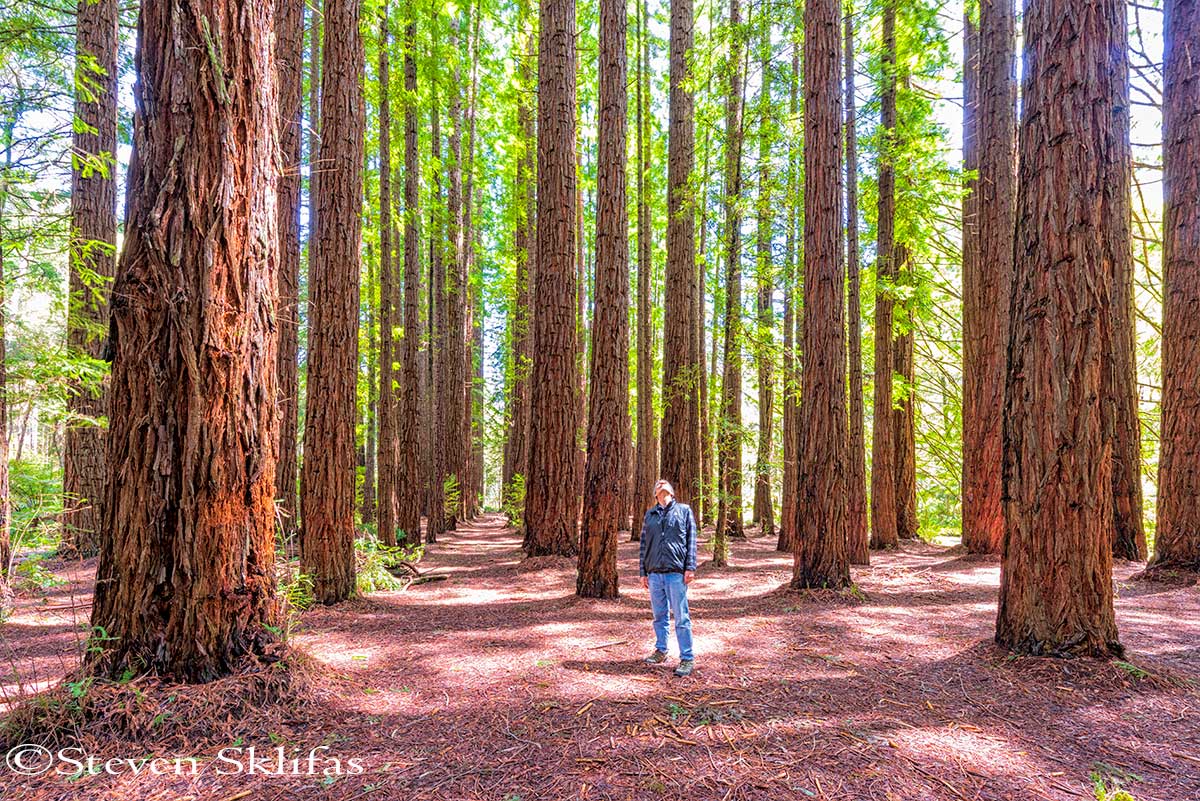
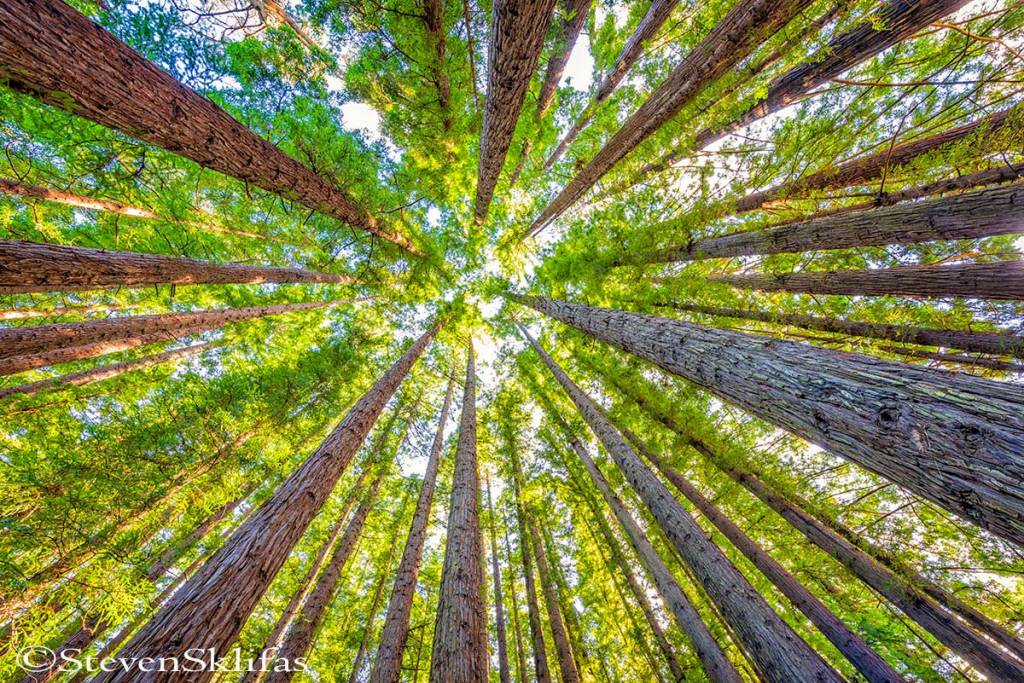
I then extended my neck to its limits, looking up towards the sunlit canopy, and viewed the giant trees reaching for the sky. I was in breathless wonder.
Canopy of Californian Redwoods (Sequoia sempervirens) which form a forest outside the town of Warburton, Victoria, Australia.
Continuing to explore, whistling, at peace, hugging, embracing the redwoods, I then had this sensation that the trees were conscious of my veneration and bliss.
Was my enraptured emotional state leading to my imagination to go into overdrive?
No, recent research has confirmed what I have always believed: that trees are conscious of their surroundings. The wise ancient Redwoods were perhaps acknowledging and warming to my sense of wonder.
Trees are sanctuaries. Whoever knows how to speak to them, whoever knows how to listen to them, can learn the truth. They do not preach learning and precepts, they preach, undeterred by details, the ancient law of life.
– HERMANN HESSE, Bäume: Betrachtungen und Gedichte
Standing in a forest of redwoods is a unique experience.
Californian Redwoods were once abundant, stretching for over 8 million hectares (2 million acres), in harmony with fellow earthlings, and a key member of the delicate and rich ecosystem.
Gold was discovered in California in 1848, and the Redwood’s fate appeared doomed. The Gold rush, with its mass migration and hysteria during the 1850s, had a devastating impact on the Californian environment, with the Redwoods almost being wiped out because of logging.
They barely survived, with only 5 percent of the original old growth forest remaining.
The redwoods being saved from extinction was an act affirming the relevance of humanity’s affinity with the natural world. The decision allowed studies to be conducted that established that redwoods forests can absorb more than twice the amount of Carbon Dioxide (CO2) than any other forests on earth.
The primary reasons are their tremendous height, longevity and resistance to rot once fallen, meaning they will continue to store atmospheric carbon for many centuries whilst laying on the forest floor. Another reason to respect and save redwoods.
Farewell
Like a child at visiting Disneyland for the first time, I was emotionally and physically exhausted. I didn’t want to leave, but longer shadows meant time had come.
The trip home was a blur as I reflected on the day, a day that was as extraordinary and humbling as I had ever experienced. A spiritual like awakening, an insight of sorts. I changed that day, and for that I will always be beholden to California Redwoods, one of mother nature’s special representatives.
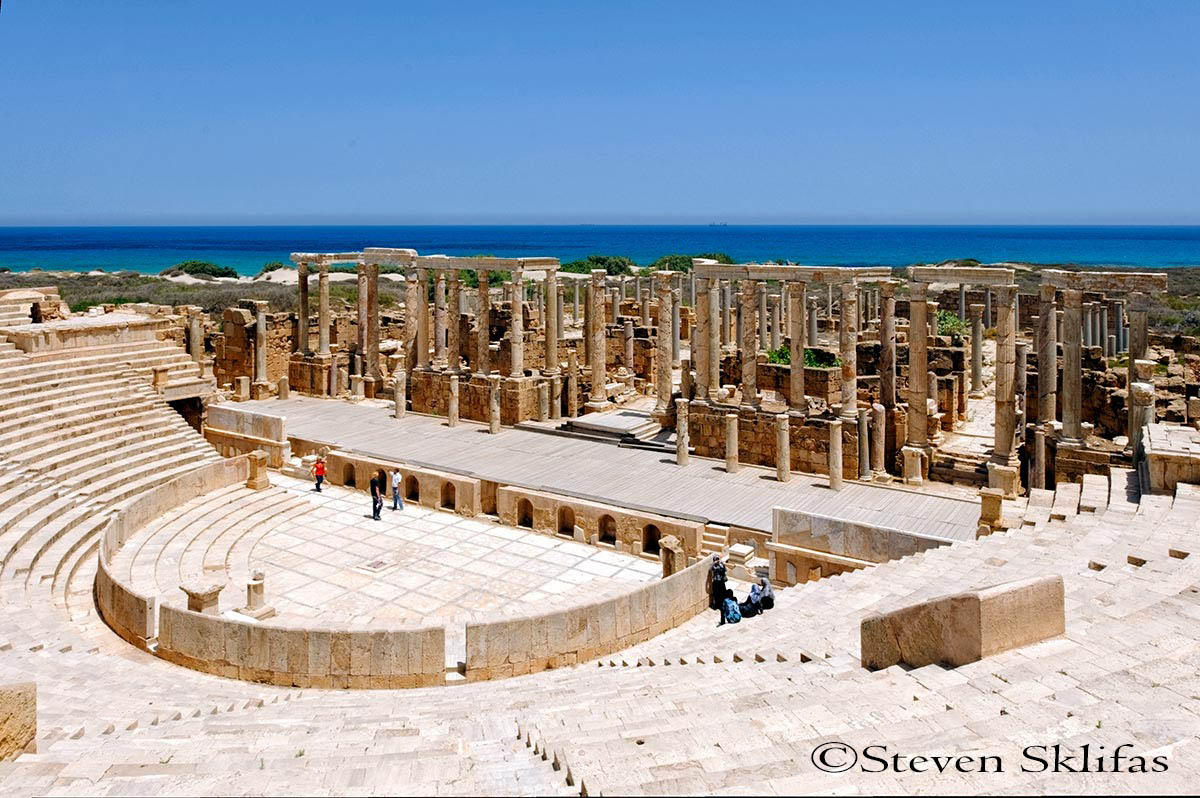
On the northwestern coast of Libya, the extensive archaeological site of Leptis Magna is one of the most splendid and unspoiled Roman sites in the Mediterranean. The ancient city encompasses some of the finest Roman monuments that were ever built.
Founded by the Phoenicians at the beginning of the 1st millennium BC, the colony existed without real influence until the 4th century BC when Carthage became a Mediterranean force. The town eventually became part of the Roman Republic (and then Roman Empire) and it was integrated in to the province of Africa around 46 BC. The city was expanded and became a major trading centre and leading city of Roman Africa during the reign of Roman Emperor Augustus and Tiberius.
The city reached its glorious pinnacle during the reign of Lucius Septimius Severus (193-211 AD), who was born there and the first Roman Emperor to be from Africa (he was of Phoenician rather than black African descent).
Severus mastered and instigated an ambitious building program that incorporated the latest and finest architectural and artistic elements, which completely transformed the city into one that was the envy of the Roman world.
What is observed now is chiefly from this remarkable age. There after the city was plundered and then become a stronghold of the Byzantine and then the Arabs. The drifting sands of the Sahara helped its preservation by burying the city over several centuries.
Leptis Magna is a UNESCO World Heritage Site. There are five UNESCO World Heritage sites in Libya – Archaeological Site of Cyrene. Archaeological Site of Leptis Magna. Archaeological Site of Sabratha. Old Town of Ghadames and the Rock-Art Sites of Tadrart Acacus.
In Southern Tunisia, the sleepy agricultural modern town of El Jem was known as Thysdrus during the Roman period around the reign of Emperor Hadrian (AD 117-38).
Strategically situated on a major crossroad on the Afro-Roman trade route (on an originally Phoenician, Punic site), ancient Thysdrus (El Jem) was a thriving town, because of its endless olive groves and olive oil production. At its peak during the Roman period, the ancient city had a substantial population of 40,000 inhabitants.
Today, El Jem’s claim to fame is its magnificent honey-coloured stone Roman amphitheatre or Colosseum, which is the third largest in the Roman world (after Rome and Capua). Without question, it is one of the most impressive Roman monuments in Africa.
Dating from 230 to 238 AD and oval-shaped, its size, and splendour and preservation rivals and in some cases exceeds the Colosseum of Rome and illustrates the grandeur and extent of Imperial Rome.
The ancient stadium seated over 35000 people and was used for gladiatorial games. It was intact until a few hundred years ago when residents started using the stone blocks for other local constructions. The Colosseum of El Jem is a UNESCO World Heritage Site.
The El Jem Archaeological Museum houses a superb and sumptuous collection of ancient mosaics discovered during excavations carried out at ancient Thysdrus. They mainly originate from the town’s former Roman villas and from the Roman Amphitheatre. In a peaceful setting, the well-presented museum itself is a restored Roman Villa known as the House of Africa. The mosaic collection is one of the finest of Roman antiquity.
Ionian Greeks established Ephesus around 1000 BC on the mouth of the now silted Kayster river on the Aegean coast and western Anatolia region of Turkey.
The city flourished during the 7th-6th centuries BC and again from the 4th century BC when it fell under the rule of Alexander the Great. After Alexander’s death, the city continued to flourish under the authority of one of his successors in Lysimachus. During this prosperous time, the Greeks erected the Temple of Artemis (Artemission) which was one of the Seven Wonders of the ancient world.
Under Roman power (1st century BC onwards) Ephesus developed into a principal seaport and commercial centre on the Aegean and its population grew to 400,000 in the 2nd century AD.
Ephesus was a key to the progress of Christianity and several biblical figures stayed here, including Saint Paul, Saint John the Evangelist and, according to some sources, the Virgin Mary.
One highlight of Ephesus is the Great Theatre, which is built on the slopes Mount Pion. Erected by the Greeks in third century BC during the Hellenistic reign of Lysimachus, the theatre was remodelled and enlarged by the Romans to what is seen today. The tiers could accommodate 25,000 people, which made it one of the largest theatres in the Roman world. Used for plays, concerts and gladiatorial events, the theatre is famous for its use by the Bible character St Paul as a place to preach against pagan worship.
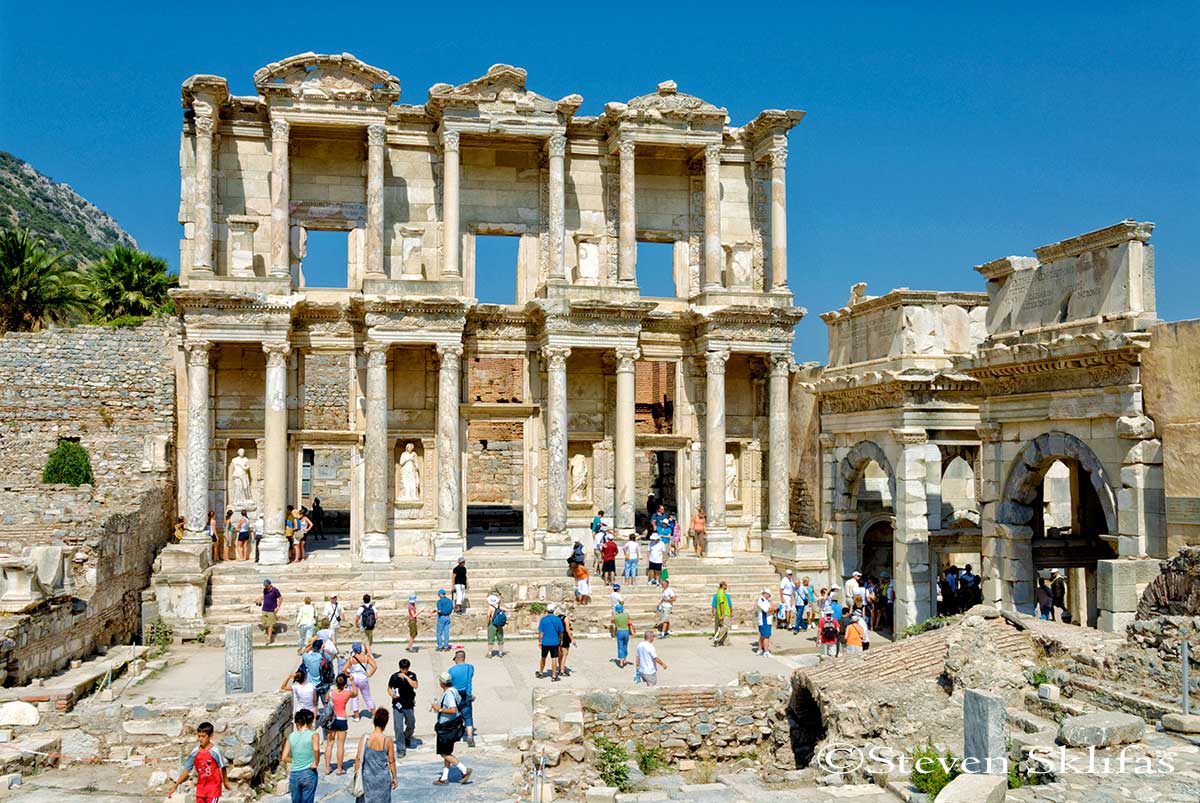
Another of the other major highlights is the Library of Celsus, which is the ancient city’s most famous building. It was erected in AD 114–117 by Consul Gaius Julius Aquila as a mausoleum for his father, Julius Celsus Polemaeanus, who is buried in a in a tomb under the apsidal wall on the right side of the back wall.
The library was one of the affluent in the empire and, at its peak, had over 12,000 scrolls. The statues observed in the niches between the doors signified wisdom, Sophia, knowledge (episteme), intelligence (ennoia) and virtue (arte) of Celsus.




 Steven Sklifas