The 18th century Royal Palace or Reggia di Caserta is Italy’s most magnificent Palace and one of Europe’s grandest Royal residences and its immense park garden is one of the most dazzling in Europe.
The Palace or Palazzo Reale was built at the behest of Charles III of Bourbon (who never ended up living there). Designed by Luigi Vanvitelli, southern Italy’s greatest architect, the construction of the Palace began in 1752 and completed in 1774.
Palace and garden were to be the pride of the Bourbon monarchy and be so beautiful as to rival and even overshadow Versailles in France.
The lavish and vast Baroque Palace comprises five storeys, 43 staircases, 1,790 windows and 1,200 rooms all arranged around four courtyards.
The royal park, also designed to rival the gardens of Versailles, stretches for 3 kilometres across the park in a straight line from behind the Royal Palace.
The immense avenue is flanked by hornbeam hedges and lined by narrow lawns and punctuated by stepped cascades, ponds, groups of statues and fountains with mythological themes. The avenue finally ends up at the base of the great cascade, a waterfall some 75 metres high which tumbles into the basin of Diana and Actaeon.
There is also a Botanical Garden known as the English Garden. The garden was the first of its type on the European mainland and is in the naturalistic style similar to those created by the famous English Landscape architect Lancelot ‘Capability’ Brown.
Caserta is located 40 km north of Naples in the Southern Italian region of Campania. I have made the trip many times via train from Rome. The station is opposite the Palace.
The Palace complex was designated a UNESCO World Heritage Site in 1997.
Facing California Redwoods is a surreal experience, one I was unprepared for when I entered nature’s majestic cathedral.
Researching the internet for day trips, I stumbled onto a website that had information about a forest of redwoods, near the township of Warburton, a pleasant 90 minutes’ drive from where I live in the northern suburbs of Melbourne, Australia.
From a young age, I have had a fascination with redwoods, so to discover that I could actually see them without flying 12,000 kilometres to California was quite incredible. Excited, I went the very next day.
The tallest trees on Earth
California Redwoods (Sequoia sempervirens), also known as Coastal Redwoods, are native to a narrow strip of the northern Californian coast. Thriving in the foggy cool moist environment found there, the Redwoods can soar to a height of 100 metres (330 feet) or more.
Discovered in 2006, the tallest tree on Earth is Hyperion, a California Redwood, reaching a height of 116 metres (380 feet). Hyperion in ancient Greek mythology was one of the twelve Titan progenies of Gaia (Earth) and Uranus (Sky).
Redwoods linage goes back 200 million years to the Jurassic period when dinosaurs roamed the Earth and are one of the oldest living organisms on Earth with the capacity to live well over 2000 years.
Why are they found so far from their native home?
In 1930, a governmental public utility body (Melbourne Board of Works) planted approximately 1500 redwoods and several other tree species (including Bishop Pine and Douglas Fir) as part of a revegetation program because of the clearing of native eucalypt trees. Additional plantings occurred in the early 1960s.
The encounter
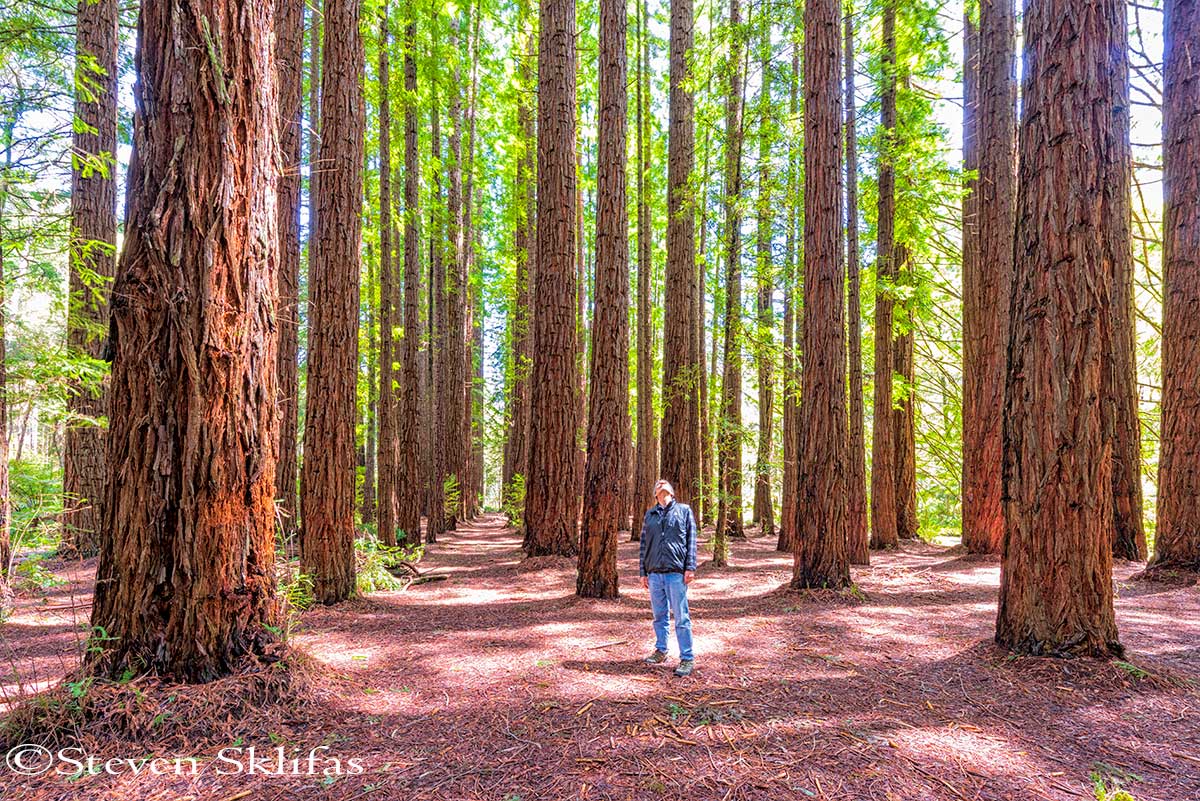
I arrived mid-morning. Almost instantly, the brilliant rays of the sun pierced through the dull, overcast sky that shadowed me from home. Was it an omen, perhaps? I excitedly gathered my camera gear and casually walked from the vast empty car park to the forest entrance. I was not expecting for the ethereal encounter that was about to take place.
The Earth moved and swayed as I magically entered another realm, a hidden world of redwoods, immense in scale, breathless in splendour and unpretentious authority.
As I gradually stepped into the forest, the redwoods curtains were drawn. Illuminating beams of sunlight penetrated the canopy, revealing the forest in its true majesty.
The forest floor, carpeted with fallen leaf needles, crackled as I moved closer to inspect the trunk of one giant. The distinctive cinnamon-red bark, thick and grooved and fire-resistant, captivated me, as did delicately soft and leathery touch of the trunk.
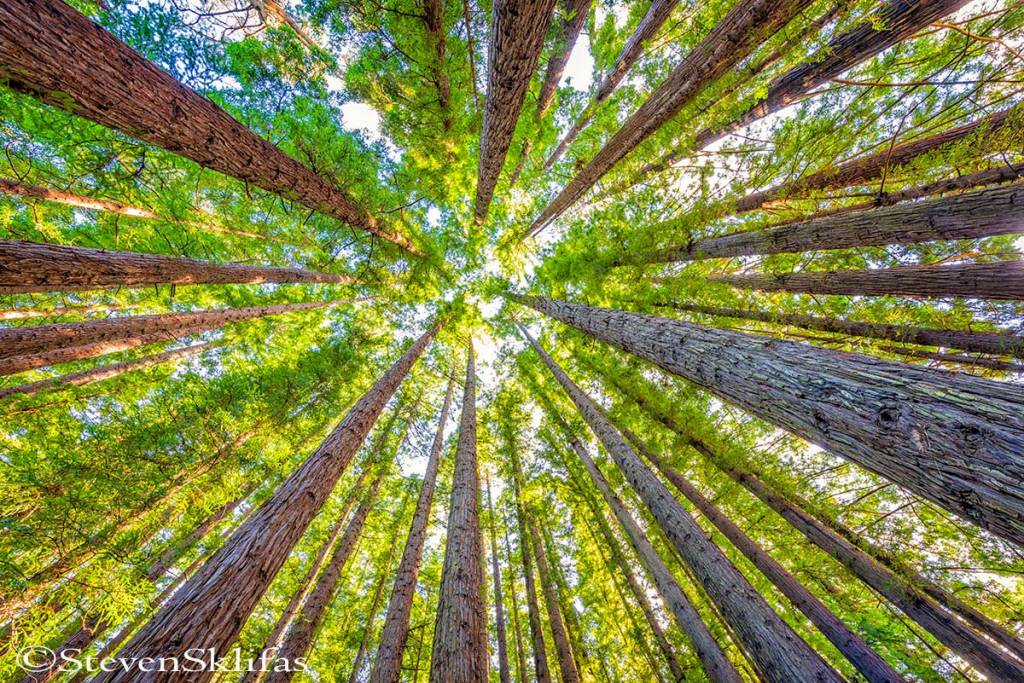
I then extended my neck to its limits, looking up towards the sunlit canopy, and viewed the giant trees reaching for the sky. I was in breathless wonder.
Canopy of Californian Redwoods (Sequoia sempervirens) which form a forest outside the town of Warburton, Victoria, Australia.
Continuing to explore, whistling, at peace, hugging, embracing the redwoods, I then had this sensation that the trees were conscious of my veneration and bliss.
Was my enraptured emotional state leading to my imagination to go into overdrive?
No, recent research has confirmed what I have always believed: that trees are conscious of their surroundings. The wise ancient Redwoods were perhaps acknowledging and warming to my sense of wonder.
Trees are sanctuaries. Whoever knows how to speak to them, whoever knows how to listen to them, can learn the truth. They do not preach learning and precepts, they preach, undeterred by details, the ancient law of life.
– HERMANN HESSE, Bäume: Betrachtungen und Gedichte
Standing in a forest of redwoods is a unique experience.
Californian Redwoods were once abundant, stretching for over 8 million hectares (2 million acres), in harmony with fellow earthlings, and a key member of the delicate and rich ecosystem.
Gold was discovered in California in 1848, and the Redwood’s fate appeared doomed. The Gold rush, with its mass migration and hysteria during the 1850s, had a devastating impact on the Californian environment, with the Redwoods almost being wiped out because of logging.
They barely survived, with only 5 percent of the original old growth forest remaining.
The redwoods being saved from extinction was an act affirming the relevance of humanity’s affinity with the natural world. The decision allowed studies to be conducted that established that redwoods forests can absorb more than twice the amount of Carbon Dioxide (CO2) than any other forests on earth.
The primary reasons are their tremendous height, longevity and resistance to rot once fallen, meaning they will continue to store atmospheric carbon for many centuries whilst laying on the forest floor. Another reason to respect and save redwoods.
Farewell
Like a child at visiting Disneyland for the first time, I was emotionally and physically exhausted. I didn’t want to leave, but longer shadows meant time had come.
The trip home was a blur as I reflected on the day, a day that was as extraordinary and humbling as I had ever experienced. A spiritual like awakening, an insight of sorts. I changed that day, and for that I will always be beholden to California Redwoods, one of mother nature’s special representatives.

 Steven Sklifas